


Italian leather bags vs mass-produced leather bags: what really makes the difference?
When people search online for Italian leather bags, they often compare them with many other leather bags that appear similar at first glance, including the many styles available today such as women’s leather bags used for everyday work or travel. At first glance, shapes, colors and styles can look almost identical. However, the differences between handcrafted Italian leather bags and mass-produced leather bags often lie in aspects that are not immediately visible: the materials used, the production process and the way the leather evolves over time.
Are Italian leather bags really different?
For many customers, the question is simple: are Italian leather bags actually different from mass-produced leather bags? In many cases, the real difference between Italian leather bags and mass-produced leather bags lies in elements that are easy to overlook. The quality of the leather, the way the bag is constructed, the production methods and the long-term behavior of the material all play an important role.
Understanding these aspects helps explain why handmade leather bags are often perceived differently from industrially manufactured ones, and why their durability and aging can vary significantly.
The origin of the leather
One of the first differences between Italian leather bags and mass-produced leather bags is the type and origin of the leather.
Many handcrafted Italian leather bags are made from full grain leather or top grain leather sourced from European tanneries. These materials preserve much of the natural structure of the hide and tend to age gradually, developing what is commonly known as a patina.
Mass-produced leather bags frequently rely on more heavily processed materials. These can include corrected leather, split leather or hides covered with thicker pigment layers that mask natural imperfections.
These treatments create a uniform appearance but also alter the natural surface of the leather. While the result may look consistent at the beginning, the long-term behavior of the material can be very different.
Italian leather craftsmanship vs industrial production
The production process is another key distinction.
Mass-produced leather bags are typically manufactured through industrial processes designed to maximize efficiency. Production is divided into multiple steps along an assembly line, where each worker performs a specific repetitive task.
This system allows companies to produce large quantities quickly while keeping costs low.
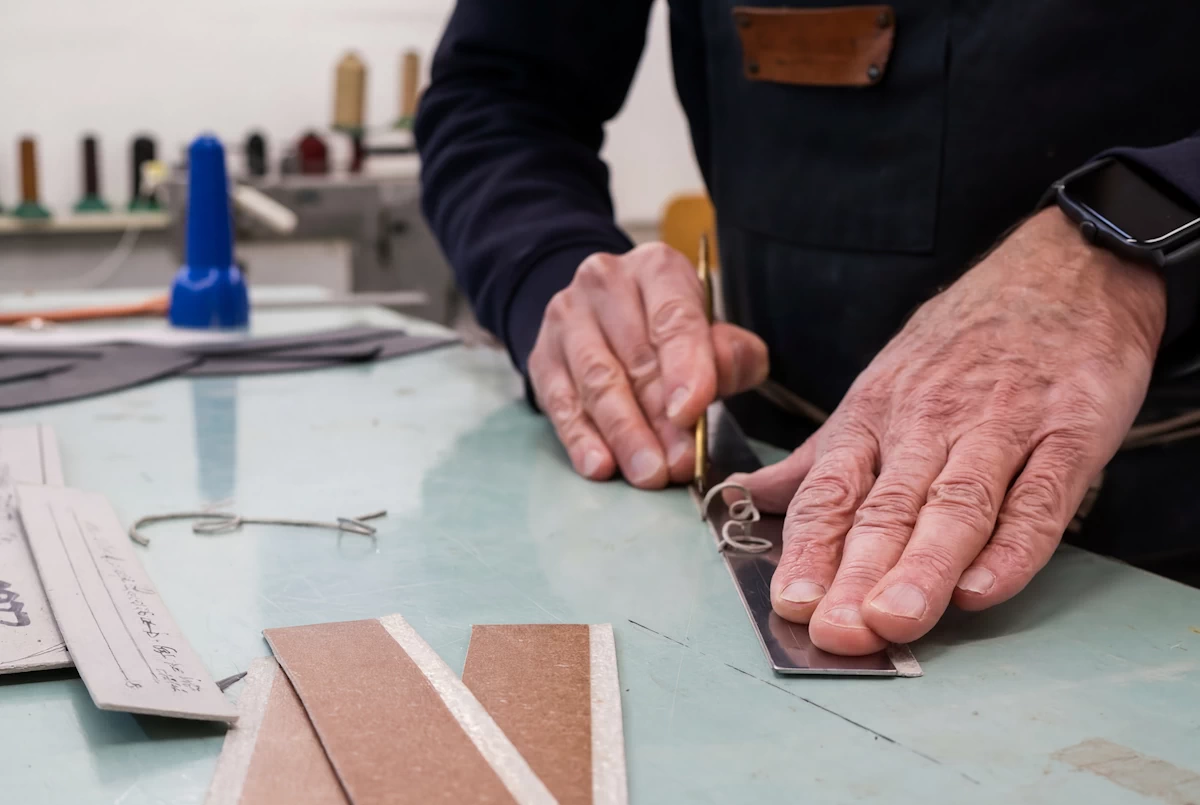
In contrast, Italian leather craftsmanship follows a much slower process. In a workshop environment, a bag is developed step by step: cutting the leather, preparing each component, assembling the structure, stitching, finishing the edges and installing the hardware.
Because production volumes are smaller, more time can be dedicated to precision and finishing.
This difference in approach is one of the reasons handmade leather bags often display subtle variations and details that reflect the work of skilled craftsmen.
Unlike mass-produced bags, small workshops can also offer custom leather bags or personalized details tailored to the preferences of each client.
| Aspect | Italian leather bags | Mass-produced leather bags |
|---|---|---|
| Production | Small-scale workshop production | Industrial large-scale production |
| Materials | Often full grain or top grain leather | Often heavily processed leather |
| Construction | Greater attention to stitching and finishing | Faster assembly methods |
| Aging | Leather develops patina | Surface may remain uniform or deteriorate |
| Price | Higher due to materials and labor | Lower due to mass production |
Construction and durability
The way a leather bag is constructed has a direct impact on its durability.
For many customers, understanding how to recognize a quality leather bag can make a significant difference. Elements such as stitching, edge finishing, leather thickness and hardware quality often reveal whether a bag has been produced with long-term durability in mind.
Mass-produced leather bags are often designed to reduce production time and material costs. This may involve thinner leather, simplified structures, glued components or lighter reinforcements in stress areas such as handles and straps.
Handmade leather bags usually follow a different philosophy. Greater attention is often given to structural elements such as stitching density, edge finishing, and reinforcement of key areas.
These details may not be immediately noticeable, but they tend to influence how the bag performs after years of regular use.
How leather bags age over time
Another important difference appears only after a bag has been used for some time.
Higher quality Italian leather bags tend to develop a patina as the leather interacts with light, movement and natural oils. Instead of deteriorating, the surface gradually acquires depth and character.
Lower-grade or heavily coated leathers often behave differently. Because their surface is more heavily treated, they may not develop the same evolution and can sometimes show cracks or peeling after extended use.
What “Made in Italy” really means
The expression made in Italy is widely associated with quality in the leather goods industry, but it is often misunderstood.
In its most authentic sense, made in Italy leather bags are designed and produced in Italy according to local manufacturing standards. This includes cutting the leather, assembling the bag, stitching and finishing the final product.
However, some products marketed internationally may use Italian leather while being manufactured elsewhere.
For this reason, when evaluating a leather bag it can be useful to look not only at the material but also at where the bag is actually produced and how it is constructed.
Why Italian leather bags often cost more
One of the most common questions concerns price.
Mass production allows companies to reduce costs by producing thousands of pieces in a single run, using standardized materials and automated processes.
Handmade leather bags follow a completely different model. Smaller production volumes, skilled labor, higher quality materials and longer production times all contribute to a higher cost per piece.
In practice, the price difference reflects the time, expertise and materials involved in creating the bag.
This is why many people ask why Italian leather bags are more expensive than mass-produced leather bags.

Choosing between handmade and mass-produced leather bags
For many customers, the choice between handmade leather bags and mass-produced leather bags ultimately depends on personal priorities.
Some people prefer an affordable accessory that can be easily replaced after a few years. Others prefer a bag designed to last longer and gradually develop character with use.
Understanding how leather bags are made and what differentiates Italian leather craftsmanship from industrial production allows buyers to make a more informed decision.
Explore our handcrafted leather bags
If you would like to explore handcrafted Italian leather bags, you can visit our collection of women’s leather bags.
Within the collection you will find different styles, including compact crossbody bags designed for everyday use and more structured shoulder bags.
Each bag is developed through small-scale production in our workshop in Rome, carefully selected leather and traditional Italian leather craftsmanship.